

Spotlight on Current Research
IFA Students Sink their Teeth (Literally!) into the Ephemeral Arts in Prof. Meyer’s Seminar
This Fall semester, Professor Anthony Meyer and his students are exploring why and how Indigenous makers in the Americas create works that aren’t meant to last. Inspired by Meyer’s own research on Nahua ceremonial arts from the Mexica Empire (c. 1325-1521 C.E.) and early colonial New Spain in what is today Mexico, it poses a central question: how might art historians study a work and its materiality if it no longer exists? In the course, Meyer and his students have come at this question from multiple angles. They’ve read and discussed theoretical essays and case studies on ephemeral works made by Indigenous communities from the past to the present. They’ve also examined colonial texts by Indigenous authors that describe these works and their making, as well as reports by international scholars that analyze their remains at archaeological sites. And, to complement these more traditional approaches, they’ve discussed how one might use experimental methods, namely how to develop research projects that recreate such works using modern materials.
To illustrate this method, Meyer designed a workshop that allowed his students to recreate a group of amaranth sculptures made by Nahua religious leaders during Mexica rule. In the sixteenth-century Nahuatl language, these sculptures were called tepīcmeh , or “created ones,” and they were made entirely from natural materials like sticks, maguey sap, and seeds of amaranth, maize, beans, and squash. To date, these sculptures have never been recovered archaeologically, and so how scholars have come to understand them is namely through early colonial Nahuatl texts and drawings, as well as by observing related practices among Nahua communities today. Before arriving to class, students read several selections from the Historia universal , a sixteenth-century set of books created by Franciscan friar Bernardino de Sahagún and a group of Nahua men in New Spain. With twelve books on different topics, the Historia is a remarkable archive of Nahua history and culture. In fact, one of its books is dedicated entirely to Nahua ceremonies that were in placed during the Mexica Empire, and it includes several passages in both Nahuatl and Spanish, as well as a handful of painted images, that describe and illustrate the making of tepīcmeh. Alongside this primary source and its translation, students in the class also read a selection of secondary sources on Nahua religion, as well as an ethnographic essay on amaranth sculpture making among Nahua communities in Guerrero, Mexico to prepare them for the workshop.
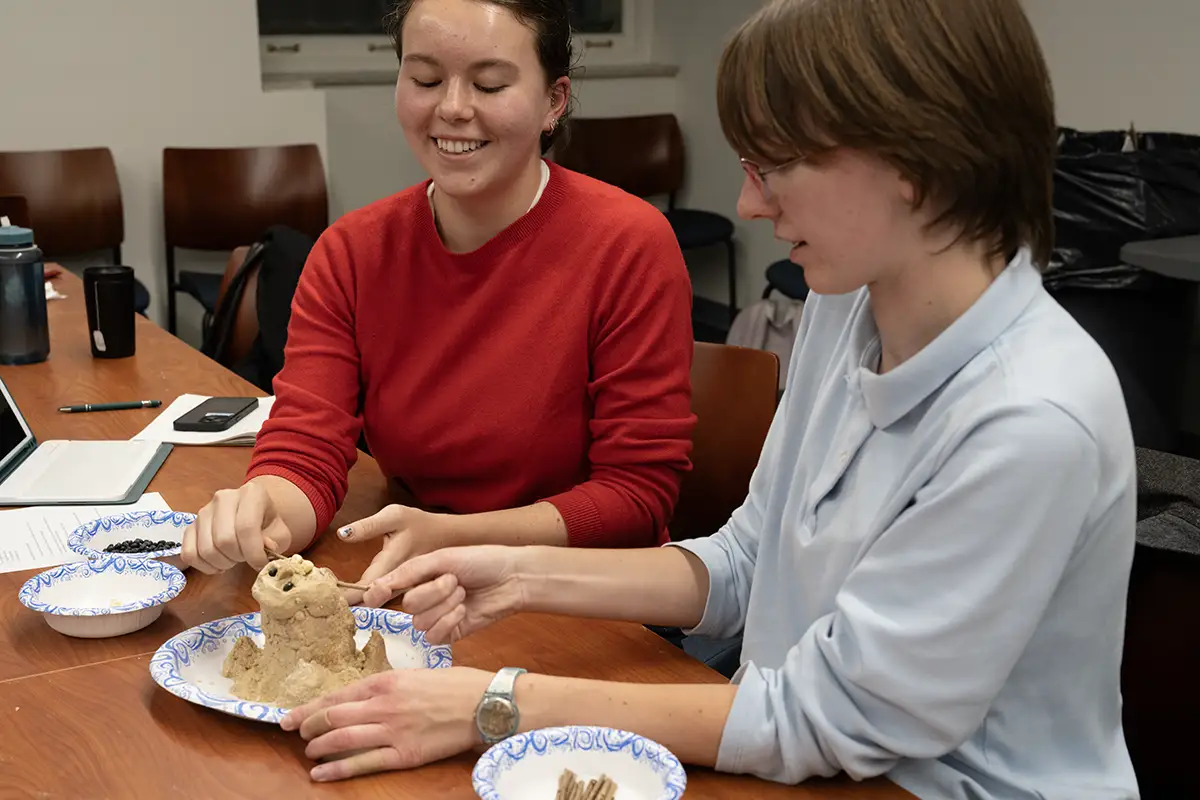
When they arrived to class, students were presented with the very materials used to make tepīcmeh in the texts they had read. Working in pairs, Meyer instructed them to devise their own recipes and strategies based on a close analysis of the sources. They first needed to figure out the right ratio of maguey sap to amaranth flour to produce a dough that was neither too sticky nor too firm. They then had to choose a sculptural form described in the readings. Each selection required a different shaping tactic, which prompted students to determine the number of sticks needed to build the frame, the right amount of dough to apply, and how they would then shape and build that dough onto the frame. Once they had built up a basic form, students then gave them eyes and teeth made of beans and maize kernels that Meyer had sourced from Mexico.
Two students—M.A. student Claire Charvet and Ph.D. student Lauren Rooney—chose to place a small heart inside their sculpture, a design element that features in one of the Historia passages. Charvet had this to say about their approach:
“When tasked with building our own amaranth sculpture, I was struck by new questions that I hadn't considered in reading about the process. We decided to use sticks to create a framework on which to mold the dough, and also create a cavity in which a heart could be placed and retrieved after decapitation. Choices such as this were an effort to bridge the gap between what we could reference from textual sources and the physical needs of the materials in front of us. The moment we added eyes and a mouth to our sculpture, I felt a connection to our creation!”
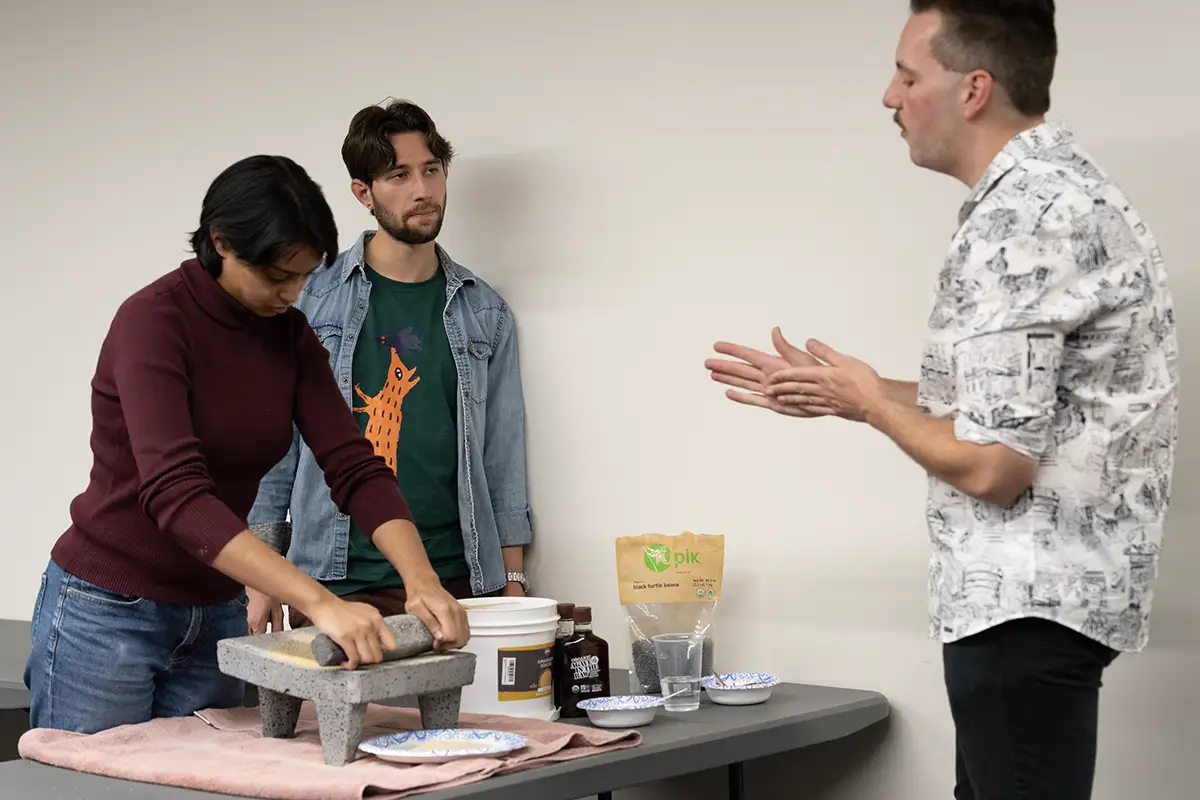
While each group designed and executed their approach, Meyer also led a small activity that allowed students to grind amaranth on a stone metate. The Historia describes how the seed was first milled on the surface of this device with a hand roller, and so part of the workshop was to understand how Nahua makers used their bodies to transform the seed into a flour. What was most surprising about this practice was actually the smell it produced. When amaranth seed is broken up, it emits a strong, earthy scent. And likewise, the grinding of such a small, hard seed on the metate abraded the surface of the volcanic stone, which released a pungent, fiery odor. Grinding the amaranth thus allowed Meyer and his students to witness how earth and fire framed the transformation of the seed into flour, sensorial aspects that were not captured by the authors of the Historia.
Even after shaping and adorning, the students’ sculptures were still not complete. In fact, many of the ceremonies that involved tepīcmeh speak of their “unmaking.” In the course, Meyer has pushed students to think of unmaking as a sort of remaking, by considering how Indigenous communities understand ephemeral works to exist in a different state of being once they become immaterial. The Historia shares that the tepīcmeh, perceived as living beings, were ritually sacrificed, broken up, and consumed at the end of several ceremonies. The ways these sculptures were killed varied, and so students each selected a method, the dominant choice among them being decapitation with a stick. Students were then encouraged to eat part of their creations, and many of them noted a sweet and earthy taste as they chewed. Ph.D. student Luis Guevara-Flores decided that he would go the extra mile and share his creation with all the participants of the workshop, re-enacting the relational and community-building acts that were so central to these Nahua ceremonies. This part of the workshop also demonstrated to students how such sculptures lived on, with their amaranth dough now incorporated into the bodies of their makers and the participants who consumed them.
In all, Meyer demonstrated for his students how they can use experimental methods to build on textual archives when studying ephemeral works. The goal of the workshop was not to recreate the historical practice perfectly, but instead to provide students with an understanding of the materials used in making amaranth sculpture, how these materials transformed during making, as well as how such works related to their makers at specific moments in their creation. This hands-on activity also opened new pathways for research beyond the more impervious facets of the archive. For instance, the earthy smell and taste of amaranth was so present during the workshop, and the texture of the dough could change based on the techniques used. Students also learned how much was required of their own bodies in the making of these sculptures. The warmth of their hands, for example, facilitated the molding process, and many students noted the growing physical strain that grinding and mixing put on their limbs. What had appeared to them initially as a straight-forward practice was quickly re-understood as one that required deft knowledge and skill.
As Meyer’s workshop illustrates, working with materials alongside textual and visual archives can and should be a critical part of art historical research. It allows art historians to become better practitioners of their discipline, tapping into and unpacking the sensorial aspects of making that are otherwise inaccessible through text and image alone. At the IFA, Meyer will keep implementing these innovative methods in his teaching, with future plans to bring Indigenous knowledge keepers and practitioners who work with ephemeral materials into the classroom.