

Public Programs @ The Institute
Series: Roundtables
“To Bear Witness”: The Art of Making Fractured Worlds from and beyond South Asia
Speakers: Roobina Karode, Artistic Director and Chief Curator, Kiran Nader Museum of Art, New Delhi; Joan Kee, Judy and Michael Steinhardt Director at The Institute of Fine Arts, New York University; Dipti Khera, Associate Professor at the Institute of Fine Arts at NYU; Ritty Lukose, Associate Professor at the Gallatin School of Individualized Study at NYU; Cara Manes, Associate Curator, Department of Painting and Sculpture, Museum of Modern Art, New York; and Fatima Quraishi, Assistant Professor of Art and Archaeology, Princeton University.
Monday, September 28, 2026, 6:00pm
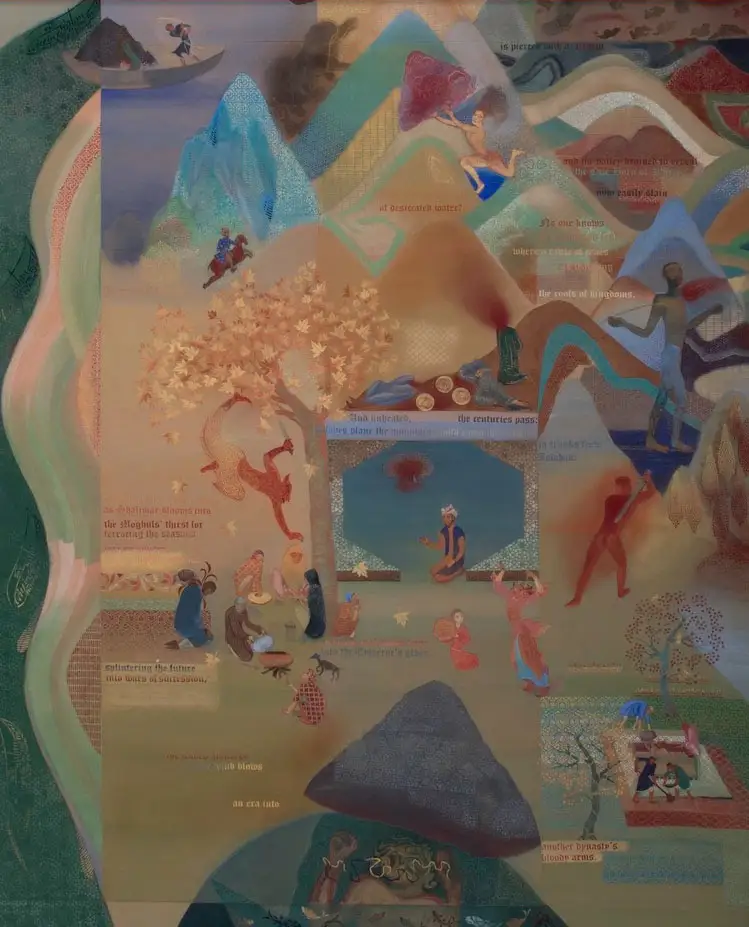
Featuring Roobina Karode, Joan Kee, Ritty Lukose, Cara Manes, and Fatima Quraishi, this roundtable will consider the enduring project articulated in contemporary artist Nilima Sheikh’s statement: “The artist’s role is to bear witness—to both the past and the present.” We will use the exhibition Fractured Skies, opening at MoMA on September 27, 2026, to consider the work of artistic witnessing through selections from Nilima’s Each Night Put Kashmir in Your Dreams (2003–10) and Home, Lan (2023–25), presented alongside Shahid/Witness (2025–26), her most recent reflection on war, climate change, and struggles for justice. Moderated by Dipti Khera, the roundtable will bring Nilima Sheikh together with the exhibition’s co-curators and invited scholars. We will ask what it means for contemporary artists to work with historical arts, archives, and materials while confronting landscapes torn by armed conflict, environmental catastrophe, and gendered violence within and beyond South Asia. Nilima’s minute figures, words, and patterns, painted in layers of casein tempera across monumental canvas scrolls, suture literary and vernacular stories from the past to individual and collective memories in the present. Encountering their immersive worlds evokes awe and pain as contested histories of place and displacement, artisanal labor and loss are remapped. Drawing on perspectives from curatorial practice, feminist interventions, and material histories of Kashmir, the conversation will consider what artistic witnessing makes visible and possible—and the burdens it carries and demands it places on artists and viewers.
Nilima Sheikh was born in Delhi, in 1945. After studying History at Delhi University between 1962 and 65, she studied Painting at the Faculty of Fine Arts, The Maharaja Sayajirao University of Baroda between 1965 and 71, where she learnt the linguistics of varied art-making processes. She has since investigated the grammar of preferred pictorial languages and tempera technologies. While exploring historical art forms through the lens of personal subjectivities, she uses a range of visual and literary sources in her work, including the Sanjhi stencils from Mathura. Working on different scales and surfaces since, she has exhibited her works at numerous venues in India and outside. Her participation in significant recent exhibitions include: The Imaginary Institution of Indian Art, London, 2024; Thinking Historically in the Present, Sharjah Biennial 15, Sharjah, 2023; Woman is as Woman does, CSMVS Museum, Mumbai, 2022; Miniature 2.0, Pera Museum, Istanbul, 2020; Dhaka Art Summit, Dhaka, 2020, Kochi Muziris Biennale, Kochi, 2018; and Documenta 14, Athens and Kassel, 2017.
Nilima’s recent solo exhibitions have been: Lines of Flight: Nilima Sheikh Archive, Asia Art Archive, Hong Kong, 2018, Terrain: Carrying Across Leaving Behind at Chemould Prescott Road, Mumbai, 2017, and Gallery Espace, New Delhi, 2018; Each Night put Kashmir in your Dreams at The Art Institute of Chicago, Chicago in 2014. She has collaborated with artists and craftspeople from Srinagar and Baroda on a multimedia mural project Conjoining Lands, for the airport terminal in Mumbai. She has written on art in books, journals and for catalogue essays since 1971, done scenography for theatre, and also illustrated books for children. Nilima Sheikh lives and works in Baroda.
Nilima Sheikh: Fractured Skies is an exhibition devoted to the work of Indian artist Nilima Sheikh (b. 1945) organized by The Museum of Modern Art, New York (MoMA), and the Kiran Nadar Museum of Art, New Delhi (KNMA). On view at MoMA from September 27, 2026, through June 13, 2027, this first solo presentation of the artist’s work in New York showcases the artist’s visionary practice through a selection of works from the past two decades, including a new site-responsive set of paintings making its debut at MoMA and commissioned by KNMA.
The exhibition is organized by Cara Manes, Associate Curator, Department of Painting and Sculpture, MoMA, and Roobina Karode, Artistic Director and Chief Curator, KNMA, with Elizabeth Wickham, Curatorial Assistant, Department of Painting and Sculpture, MoMA, and Avijna Bhattacharya, Senior Curator, KNMA.
This roundtable is supported by the Institute's Fund for South Asian Art History and the Gallatin School of Individualized Study.
Roobina Karode is the Artistic Director and Chief Curator at the Kiran Nadar Museum of Art (KNMA) in New Delhi, India. She has been with the museum since its inception in 2010. With postgraduate specialisations in Art History and Education, Karode has been a significant presence in the art world as an educator, writer, and curator. Before leading KNMA, she taught Art History, including Indian Modern and Western Art, at various institutions in Delhi from 1990 to 2006, including the School of Arts & Aesthetics at JNU (Delhi), the National Museum Institute (Delhi), and the College of Art (Delhi). She was awarded the Fulbright Fellowship in 2000 and the Ford Teaching Fellowship for 2005-2007. In 2016, she received the India Today Best Curator Award, and in 2019, she curated the India Pavilion at the 58th Venice Biennale.
Karode's extensive curatorial work, both in India and internationally, consistently prioritises underrepresented intergenerational artists whose contributions are crucial to the discourse of modern and contemporary Indian and South Asian art. For the past fifteen years at KNMA, Karode has been instrumental in re-contextualising exhibition practices and art historical contextualisation of South Asian art and artists, deliberately moving away from established frameworks. Under her leadership, KNMA operates on the belief that museums are more than just repositories; they are dynamic spaces for confluence and critical conversations.
Joan Kee is the Judy and Michael Steinhardt Director of the Institute of Fine Arts at New York University. Widely credited with bringing international attention to the body of Korean abstraction known as Dansaekhwa, her books include The Geometries of Afro Asia: Art Beyond Solidarity (2003). She is currently curating an exhibition on African and Asian artistic intersections at MoMA, opening in Summer 2027. Her current research proposes how form follows its own geodesic, curved not by influence or affinity but by the mass and density of what a field carries forward over time.
Ritty Lukose is Associate Professor of Anthropology, Gender/Sexuality/Feminist Studies and South Asian Studies at the Gallatin School at New York University. She is the author of Liberalization's Children: Gender, Youth and Consumer Citizenship in Globalizing India (Duke, 2009) and co-edited a book, South Asian Feminisms (Duke, 2012). A co-edited book with Tejaswini Niranjana is forthcoming entitled Digital Intimacy: Young Women, Gendered Modernities and Aspirations in Inter-Asia (Routledge, 2026). She has published book chapters and articles in journals such as Cultural Anthropology, Social History, Social Analysis, and Anthropology and Education Quarterly. Recent publications include “Decolonizing Feminism in the #MeToo Era” in The Cambridge Journal of Anthropology, a co-edited special section of the journal South Asia titled "Pedagogies of Aspiration: Anthropological Perspectives on Education in Liberalising India", “South Asia” in The Routledge Global History of Feminism and “The Great Indian Kitchen: Taste, Distaste, Feminism and Women’s Emancipation” in Verge: Studies in Global Asias.
Cara Manes is Associate Curator in the Department of Painting and Sculpture at The Museum of Modern Art. At MoMA, she has worked closely with the Museum’s collection since 2008, focusing on its ongoing research, development, and presentation. She has also organized or co-organized numerous exhibitions, most recently Nilima Sheikh: Fractured Skies (2026–27). Other exhibitions include Ruth Asawa: A Retrospective (2025); YOU ARE HERE: Contemporary Art in the Garden (2023); Alexander Calder: Modern from the Start (2021); two Artist’s Choice exhibitions, with Peter Fischli (2018) and Trisha Donnelly (2012); and The Long Run (2017). Her research and writing engage with a range of topics in modern and contemporary art, and she holds degrees from Wellesley College and The City University of New York.
Fatima Quraishi is Assistant Professor of South Asian Art at Princeton University. Her forthcoming book, Palimpsests Past and Present: The Sufis and Sultans of the Makli Necropolis (1380–1660) (UNC Press, 2026) is an interdisciplinary study of a vast funerary site in the amorphous landscape of the Indus deltaic plain and explores the vital place of funerary landscapes in shaping and sustaining communities. The book has been awarded the 2026 Edward Cameron Dimock, Jr. Prize in the Indian Humanities by the American Institute of Indian Studies. Building on her interests in affective relationships between communities, the built environment, and ecology, her second book focuses upon a set of monumental painted and embroidered maps of the Kashmir Valley and the city of Srinagar produced in the eighteenth and nineteenth centuries and the role of artists in producing geographic knowledge at a pivotal moment in South Asia’s history. Quraishi's work has been supported by fellowships at the Society for the Humanities (Cornell University), the Center for Advanced Study in Visual Art (National Gallery of Art), and the Metropolitan Museum of Art. Prior to Princeton, she held teaching positions at the University of California Riverside, Indus Valley School of Art and Architecture, and Shaheed Zulfiqar Ali Bhutto Institute of Science and Technology. In 2017, Quraishi curated the exhibition, “Paradise on Earth: Manuscripts, Miniatures, and Mendicants from Kashmir,” at the Mohatta Palace Museum in Karachi.
*The Institute of Fine Arts provides reasonable accommodations to people with disabilities. Requests for accommodations for events should be made at least two weeks before the date event. Please email ifa.events@nyu.edu for assistance.
As a participant in our public programs, we ask that you review and abide by the Institute's Community Standards Policy which provides for a positive and educational experience for all of our guests.